AFT Fathom Validates Power Plant System Conversion
AFT Fathom™ Case Study
Sargent & Lundy LLC | Circulating Water System | Power Generation

“The simulation…confirmed that the overflow lines would…prevent
the cooling tower basin from overflowing. This would have been
massively difficult to determine with hand calculations or less capable
software.”
– Matt Thomas, Senior Engineer
PROBLEM
- Converting power plant cooling water system from an open circuit to a closed loop
- Analyzing system behavior with operation changes over time
ANALYSIS
- AFT Fathom was used to build and analyze the new system
- XTS add-on module allowed the engineers to look at changes over time
SOLUTION
- Predicted basin water levels with different scenarios, such as a pump trip
- Sized an overflow line to be used when water levels get too high
Ready to try AFT Fathom?
Problem Explained
Sargent & Lundy was tasked with modeling a circulating water system for an undisclosed four-unit power plant located in the eastern U.S.
The project involved converting an existing open-loop circuit—where water is taken from and discharged to a local river—to a closed-loop system where the water is instead routed to a new cooling tower (see Figure 1). This system provides cooling water to the plant condensers to reject heat and to condense the exhaust of the steam turbines.
The plant modification presented many challenges because it integrated new and old equipment. The existing circulating water pumps, intake basin, piping and concrete tunnels were reused. The new equipment included a cooling tower pump basin, four cooling tower pumps, a 16-cell cooling tower and the cooling tower basin. New piping was also added between the cooling tower pump basin and the cooling tower, as well as between the cooling tower basin and the existing intake basin.
Tools & Analysis
Matt Thomas, senior engineer at Sargent & Lundy, used AFT Fathom and the Extended Time Simulation (XTS) module to model the system conversion.
In addition to the XTS module, several software features were used to model potential complications with the addition of the new equipment. These features included: finite open tanks with both constant and variable cross section, variable speed pumps, a transient event triggered by time and a transient event triggered by pressure.
All of the scenarios were run using the XTS module to model the long term transient effects on liquid heights in the cooling towers and to see how the non-tripping pumps would react over time to changes in static head.
Finite open tanks were used to model both the existing and new water basins, allowing Thomas to determine the basin water levels under both steady-state conditions and transient events such as pump trips and plant shutdowns.
Solutions & Benefits
“The software allowed us to determine if and when the basins would overflow or empty during a pump trip scenario,” Thomas said.
Thomas made use of the variable speed capability of the pump junction to simulate the flow rate from the new variable speed pumps into the pump basin. He also used the pump junction’s transient capability to model a pump trip from steady-state conditions, reducing the pump flow rate to zero over a short time and simulating a trip.
Lastly, AFT Fathom’s valve junction transient capability was used to simulate an open pipe filling up with water and acting as an overflow line. This simulation assisted in selecting the required pipe size and elevations as well as confirmed that the overflow lines would operate properly and prevent the cooling tower pump basin from overflowing.
“This would have been massively difficult to determine with hand calculations or less capable software, if for no other reason than it would have been difficult to account for the change in pump flow rate as the source and basin water levels changed, which changes the operating pump head,” said Thomas.
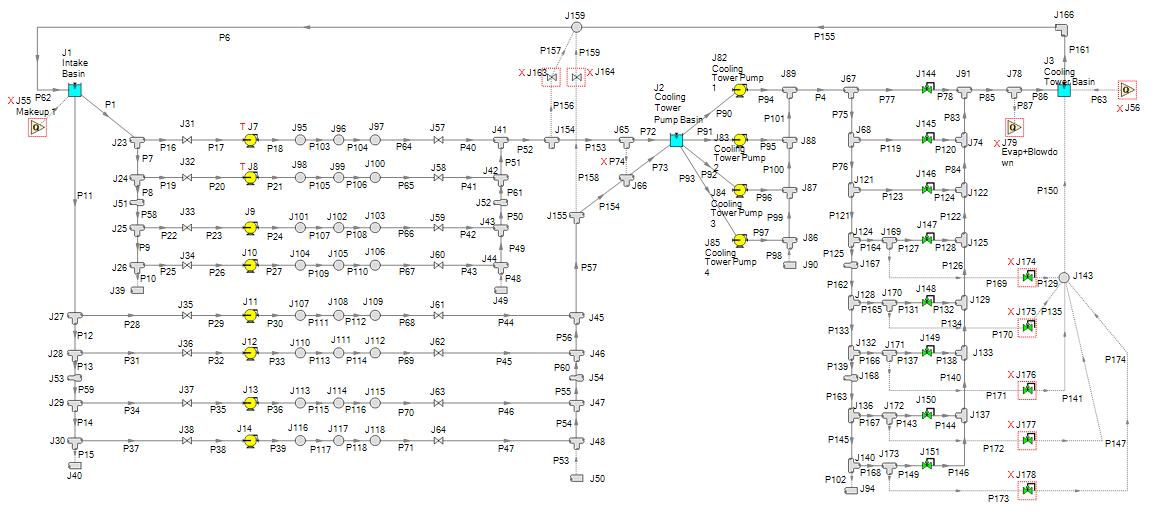
AFT Fathom model of a closed-loop system where water is routed to a new cooling tower
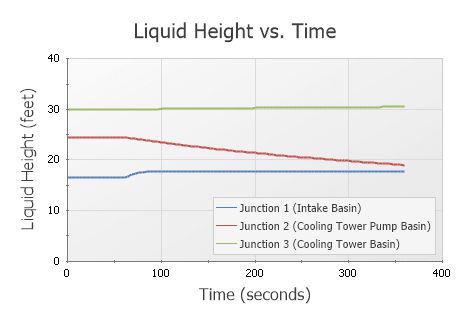
Liquid Height vs. Time for the main basins of the power plant’s circulating water system as predicted by the XTS module