AFT Impulse Finds Solution to Mitigate Surge Risk in Oil Pipeline
AFT Impulse™ Case Study
URS | Oil & Gas Industry

“The ability to calculate transient response and the flexibility to enter
different valve coefficient vs. time values were crucial in allowing URS
to consider multiple solutions that would reduce risk [for both Colonial and BP].”
– Steve Schade, Senior Process Engineer
PROBLEM
- Reduce surge risk in existing oil pipeline
- Balanced needs from both BP’s downstream tank and Colonial’s upstream pumping station
ANALYSIS
- AFT Impulse model indicated flaws with proposed control valve solution
- Considered different mitigation efforts and various worst-case scenarios
SOLUTION
- Implementation of a relief valve satisfied both upstream and downstream client
- Relief valve was properly sized, and its impact on steady state operation was determined
Ready to try AFT Impulse?
Problem Explained
An existing oil/gas pipeline ran from Colonial’s pumping station to BP’s tank in Carteret, New Jersey, USA. Both parties wanted to ensure the safety of their own systems, protecting them from high surge pressures. Steve Schade, senior process engineer at URS, used AFT Impulse to perform a study using several different mitigation scenarios.
BP had proposed a high integrity pipeline protection system using a control valve that attempted to control pressure, while an upstream valve closed to protect the system.
Tools & Analysis
Modeling with AFT Impulse proved the concept.Additional scenarios, for worst case occurrences such as power failure, were run showing high pressures in the upstream piping. This created unacceptable risk to the Colonial pipeline.
A relief valve was added to the model and the control valve was deleted. AFT Impulse showed that the relief valve alone would protect both Colonial and BP piping (see Figure 1). The ability to run a steady state model first to determine the coefficient was important. This coefficient could then be entered to run the transient model.
Solutions & Benefits
Standard AFT Impulse capabilities such as the ability to calculate transient response and the flexibility to enter different valve coefficient vs. time values were crucial in allowing URS to consider multiple solutions that would reduce risk on both sides. The new relief valve feature was a key to the final solution.
When asked about the benefits of AFT Impulse, Schade provided the following:
- “Ability to predict surge pressures for valve closing as well as for worst case scenarios.”
- ”Ability to analyze mitigation approaches other than the accumulator that is supplied with Impulse.”
- ”Ability to graph results in a format that was required by the client.”
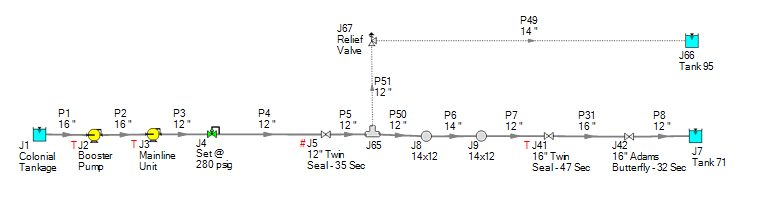
FIGURE 1: AFT Impulse Model. Adding the relief valve protected both Colonial and BP piping

Colonial Pipeline Company