AFT Fathom Instrumental in District Cooling System Planning, Development & Operation
AFT Fathom™ Case Study
NRG Thermal Corporation | District Cooling | Commercial Building

“In emergencies, [AFT Fathom] allows quick evaluation of
sequences and provide[s] reasonable guidance to
operation personnel.”
– Slava Prash, NRG Engineering Manager
PROBLEM
- USA’s largest district cooling system in downtown Minneapolis made up of 5 plants with 18 chillers
- Needed accurate reference for emergencies and expansions
ANALYSIS
- An AFT Fathom model was built and calibrated to meet existing system measurements
- Model was confirmed to within 2% difference from field data
SOLUTION
- Instrumental to planning expansion and guidance to transfer capacity during maintenance or emergencies
- Optimized system lineup, making load distribution across plants more efficient
Ready to try AFT Fathom?
Problem Explained
Among NRG Thermal’s many facilities is the District Cooling System serving downtown Minneapolis, MN. Begun in 1971 as a small chilled water plant for air conditioning, it has grown into one of the country’s largest with a total capacity of more than 35,000-tons (123,000 kW) and 80,000 gal/min (18,200 m3/h).
The system includes 5 plants with 18 chillers and multiple distribution loops providing for extensive sectionalizing and bypassing to help assure a 99.98% reliability of chilled water supply. The system was named the “System of the Year” in 1996 by the International District Energy Association.
Tools & Analysis
To assist in the planning, development and operation, an AFT Fathom model of the system was developed. Over the years of using the AFT Fathom model, a new plant, 8 chillers and several customers have been added to the system.
Directly related to the benefits of modeling this complex system with AFT Fathom is the high level of accuracy of Fathom’s predictions. By investigation, NRG determined they could simplify the modeling of the many customers (buildings) to be represented by a flow control valve. This sets model flow rates to precisely match the actual system flow rates.
To confirm the accuracy of the system model, inlet and differential pressures at 43 buildings were recorded in 15-minute periods over numerous iterations while the system was near peak demand.
Solutions & Benefits
The results? With an average inlet pressure at the 43 buildings of 132 psig (900 kPa (g)), the average difference between the actual and Fathom predicted pressures was 2.3 psi (16 kPa), or less than a 2% difference.
Several advantages of using AFT Fathom:
- Very instrumental for planning system development and growth
- Allows evaluating of capacity to be transferred through branches of the manifold for scheduled maintenance or emergency shutdowns and predicts limitations to individual customer loads during such periods
- Ideal optimization tool for planning system lineup for efficient load distribution between cooling plants. Particularly important as some of the plants do not have permanent staff so use of manpower can be optimized as well
- In emergencies, allows quick evaluation of scenarios and provides guidance to operating personnel
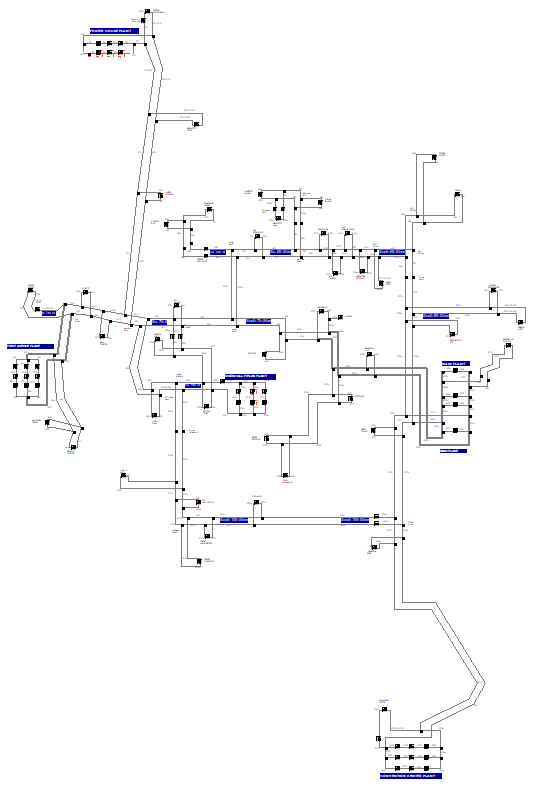
Figure 1 – Minneapolis District
Cooling System AFT Fathom model
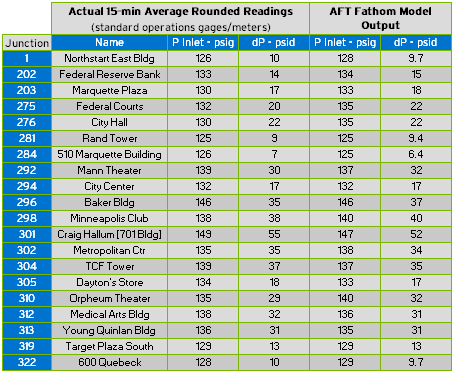
Table 1 – A portion of the operating data gathered from the District Cooling System and comparative AFT Fathom predicted values