Campus Chill Water System Improved Through Hydraulic Modeling with AFT Fathom
AFT Fathom™ Case Study
TME Energy Services | Chill Water | Campus & Educational Facility

“Annual energy savings of 1.9 million kW-hr and $67,000 in
pumping power, and $1.2 million in annual chiller electrical and
gas energy savings.”
– James Hess, Energy Engineer
PROBLEM
- University of Arkansas Fayetteville was undergoing an expansion, impacting the campus chilled water system
- Energy reduction was a forefront design requirement
ANALYSIS
- AFT Fathom was used to model the existing system and proposed changes
- Fathom’s ability to analyze VFDs, control schemes, and over 3,400 pipes made the project feasible
SOLUTION
- The campus saved $1.2M annually in electrical and gas energy
- Saved an additional $67K in pump power costs
Ready to try AFT Fathom?
Problem Explained
Reducing energy costs is an increasingly important consideration for plant owner/operators with an excellent example being the energy intensive district cooling system serving the University of Arkansas at Fayetteville (UAF). This campuswide system provides air conditioning for 59 buildings along with refrigeration heat rejection for laboratories and laser systems cooling.
Classified as a primary/secondary /tertiary pump system, the primary circuit circulates water within the chiller plants, the secondary system distributes cooling water from the plants to the buildings and other users, and the tertiary system consists of pumps within the various buildings. With a total connected load of 13,600 cooling tons (48,000 kW), the system includes the Main Chiller Plant with a pumping capacity of 15,000 gpm (3,400 M3/hr), the Southwest Chiller Plant with 9,000 gpm (2,000 M3/hr) capacity and the North Chiller Plant with a capacity of 6,000 gpm (1,400 M3/ hr).
As is the case with many growing universities, UAF was undergoing significant changes that would greatly impact the district cooling system.
Tools & Analysis
In addition to campus load growth, it was desired to evaluate changes to reduce pumping energy costs. Supplying colder chilled water to the campus buildings, converting the buildings to variable flow using variable speed pump drives and eliminating the ‘decoupler’ at each building, allows the primary system to take advantage of differential pressure in the secondary system. These changes were cumulatively referred to as the “Low Flow/High Delta-T” project. Finally, an operating strategy for the chiller plants to minimize pumping energy was developed. No mean feat given the complexity of this system.
To answer these questions, a model of the district cooling system was developed within AFT Fathom. In addition to the ability to model complex and large networks (the model contains more than 3,400 pipes and junctions), unique capabilities provided by AFT Fathom were critical to the success of the study.
Solutions & Benefits
Air conditioning load calculations were developed for average and peak demand periods during winter and summer. Cooling load data was then converted into flow demands for the many heat exchangers in the system. Modifying the input for 358 pumps and control valves over the many different load cases studied was greatly facilitated by using AFT Fathom’s Excel data import capability.
As James Hess, energy engineer at TME, comments, “Now that we had a method for quickly making changes to the models, the real fun began.” A series of runs were made with varying loads, operating configurations, pump characteristics and piping changes.
In the end, the hydraulic model and results achieved by the study were viewed very favorably by the university.
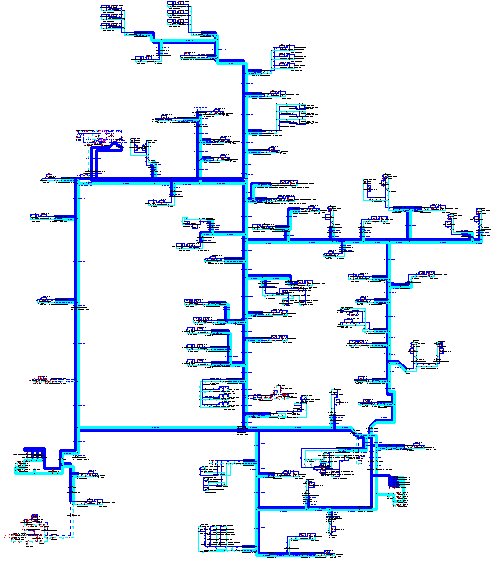
University of Arkansas Chilled Water System

University of Arkansas Main Cooling Plant