Hydraulic Analysis: Dry Fire Line Piping Network for Twin Tunnel Subway Design Project Using AFT Fathom
AFT Fathom™ Case Study
Hatch Mott MacDonald | Dry Fire Line System | General Facility

“AFT Fathom is, above all, reliable software. This is crucial to Hatch Mott MacDonald, a
company whose reputation depends on the reliability of the final product.”
PROBLEM
- Fire protection system from subway expansion and new Light Rail transit
- Strict design requirements from governing standards
ANALYSIS
- AFT Fathom was used to model the proposed changes
- Analyzed overall system behavior along with pressures at the most hydraulically remote fire valves
SOLUTION
- Design was installed into each section of new subway tunnels, stations, and emergency exits
- New designs and expansions can easily be tested with existing model
Ready to try AFT Fathom?
Problem Explained
The Toronto Transit Commission (TTC) hired Hatch Mott MacDonald as consulting engineers on two upcoming tunneling projects: a subway expansion and a new Light Rail Transit system. The design of all commuter tunnels involves careful consideration to the fire protection system that will safeguard the public in an incident of emergency.
A Dry Fire Line (DFL) piping system is used for the suppression of fire in the tunnels with governing standards that outline strict design requirements. These complex piping systems require in-depth hydraulic analysis to calculate system parameters such as outlet pressure and flow rate.
Tools & Analysis
A DFL system is composed of pipe networks, fittings, valves, and hose connections that are empty, or dry (to avoid freezing in non-heated spaces in cold climates), and are filled with water only when an emergency situation arises. The water source for the DFL system is normally a local fire hydrant that connects to a fire department pumper truck and ultimately to a set of fire department connections located at grade. Water is pumped from grade to the tunnels through the DFL piping network and supplies water to a series of fire hose connections, strategically located along the tunnels.
A hydraulic model of the DFL piping network was created in AFT Fathom to study the pressure drop in the system by regulating the input pressure at grade and output pressure at the farthest set of fire valves in the tunnels. The model includes different scenarios, depending on flow direction and operational fire valves. This design will be installed into each section of new subway tunnels, between stations and at emergency exit buildings.
Solutions & Benefits
According to Hatch Mott McDonald, there are many benefits of using AFT Fathom software.
- Allows preliminary designs to be tested, and based on the results, either continue designing or begin generating new and better ideas.
- Is a time-saving alternative that limits hand calculations to verification of the design, not the design itself. AFT Fathom’s software stability eliminates man-hours spent on troubleshooting.
- Provides wide model flexibility. Effortless global junction and pipe specification modifications, combined with Excel data importing, allow for seamless adjustment of existing models to new requirements.
- Is transparent in its methods. The detailed user guide allows engineers to fully understand and trust what the software has produced.
- Makes reporting results easy through its customizable output layout. Results can be easily copied or exported and parameters and junctions can be reordered to best suit a specific application.
- Presentable models. Junction display options, background pictures, and varying pipe thicknesses make the models more realistic, and easily understandable.

Dry Fire Line Piping Network for a Twin Tunnel Subway
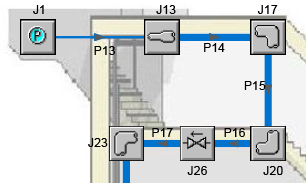
Twin Tunnel Subway Dry Fire Line Station