
Steam & Gas Transient Analysis Software
AFT xStream™ 3
What Is
AFT xStream
AFT xStream is a powerful fluid dynamic simulation tool for high-speed, acoustic transients that occur in steam and gas piping systems. Uncertainty in design and operations costs money and time. Now you can accurately simulate how your steam and gas systems will respond to potentially disruptive transient events.
How It Works
Modules
Validation Resources
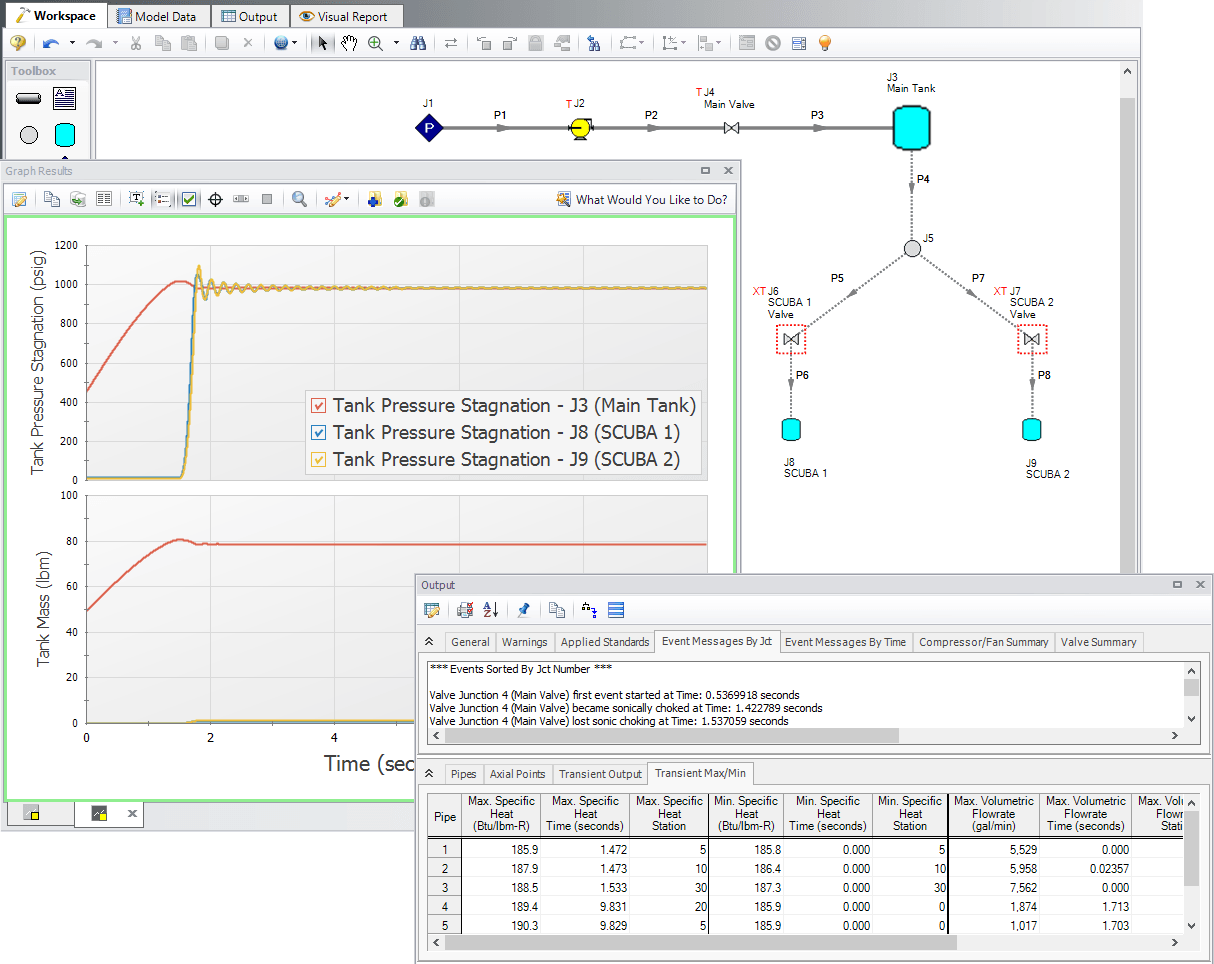
How Does It Work?
AFT xStream™ incorporates a highly accurate steady-state solver which provides seamless transfer of initial conditions to the transient analysis. Steady-state solutions are determined using a modified Newton-Raphson matrix iteration plus proprietary methods developed by AFT. A specialized Method of Characteristics is used to solve the transient mass, momentum and energy equations of pipe flow.
AFT Fathom
Add On Modules
With this software extension tools, you can quickly and efficiently
complete projects. Modules work within your existing AFT xStream models.
Pulsation Frequency Analysis (PFA)
Helps identify pipe acoustical frequencies to avoid resonance from excitation, especially in systems with reciprocating compressors.
Case Studies
No Results Found
The page you requested could not be found. Try refining your search, or use the navigation above to locate the post.

Fluids Supported
Steam
Compressed Air
Process Gases
Hydrogen & Natural Gas
Modeling & Simulation
Primary Features
Typical Applications
Reporting Features
Manage Design Variants
- Organize your design variants, operating conditions, existing infrastructure and expansions into a single file with Scenario Manager
- Batch run operating scenarios and export your results to Excel
- Easily compare design variant input to isolate changes between systems
Quickly review model input from a schematic - Compare transient response in different operating scenarios on a single graph
Refine and Report Raw Data
- Customize and organize parameters to isolate relevant information
- Report in multiple units, which can be updated without re-running your model
- Filter your results to identify areas of concern
- Export or copy results to Excel for further analysis
- Use design alerts to quickly identify parameters outside of allowable tolerances
- Report parameters section by section in your model
Visualize Your Results
- Save time with report-ready graphs
- Manage graph items and templates to re-use and compare different system set-ups
- Graph or animate parameters along a pipe length to see pressure and flow transmission
- Graph multiple parameters over time to understand system cause-and-effect
- Integrate flowrates to measure total flow over time
- Visually associate parameter results with locations in the system
- Color code your system to reflect parameter result range
- Color animate pipes in your system to see transient behavior in context
Modeling Features
Usability and Convenience
- Select pipe materials, sizes, type and schedule from built-in or custom databases
- Use built-in handbook data and heuristics for common component losses, embedded into pipes for visual simplicity
- Collect and catalogue common component and pipes into custom libraries
- Reduce redundant specification by importing your model file
- Draw your model as an isometric or on top of an aerial photography background
- Quickly make changes to common pipes and components with Global Edit
Pipes and Components
- Model component losses with Cv, K, Kv, or resistance curves
- Take control over your flow and pressure with control valves, determining valve position, capacity, and failure response
- Utilize reactionary components like check valves, relief valves, and vacuum breaker valves to confirm your system response
- Model relief valve protection, both internal or venting to atmosphere
- Display effective Cv and K factor values for all valves in the system
Fluid Propeties
- Use built-in fluid databases or create your own to calculate properties
- Mix it up with fluid mixures in NIST REFPROP or the add-on Chempak database
- Refine your real gas modeling with equations of state (Redlich-Kwong, Three Parameter, Ideal Gas, Interpolation)
- Account for changes in composition, density, and viscosity with pipe specific fluid properties
System Interaction
- Utilize reactionary components like check valves, relief valves, and vacuum breaker valves to confirm your system response
- Model where your system sonically chokes and determine the resulting losses
Transient Specific
- Induce a transient response through a valve change, pressure change, pump changes and more!
- Use event logic to model interacting components in control systems
- Calculate and export forces for pipe stress analysis
- Size, locate, and test surge supression equipment like accumulators, relief valves, and vacuum breaker valves
- Consider variable friction modeling with large flow rate changes
- Use valve characteristic curves to capture specific valve response
- Use pulsation analysis to determine and analyze excitable frequencies (with add-on module)
Typical Applications Of
AFT xStream
- Ensure pressure, temperature and flow extremes are within design allowables
- Determine imbalanced pipe forces for sizing structural supports
- Troubleshoot existing systems to determine the cause of operational problems
Primary Features Of
AFT xStream™
- Built-in steady-state solver to automatically initialize system before the transient
- Automatic pipe sectioning based on steady-state acoustic velocities
- Compound transient event logic to model complex control sequences
- Scenario Manager to track all design variants and operational possibilities in a single model file
- Integrated graphing and reporting
- Animation tools for visual interpretation of complex transient interactions
- Generates force imbalance files that can be automatically read into CAESAR II ®, ROHR2, AutoPIPE and TRIFLEX ® pipe stress dynamic models
- 2D flow diagram or isometric view interface
- Built-in libraries of fluids (including NIST REFPROP and ASME Steam Tables) and fittings which can be extended and customized
- Chempak™ add-on utility provides a thermophysical database of almost 600 gases – allows you to define non-reacting pre-mixtures and simulate dynamic flow mixing
Let's Get Started!
Want to learn more about AFT software and see if it's the right solution for you?