AFT Fathom Provides Accuracy and Confidence at Ameren Missouri
AFT Fathom™ Case Study
Ameren Missouri | Gravity Drain System | Power Generation

“AFT Fathom allowed us to
identify a previously unknown
design flaw”
– Jeff Shelton, Performance Engineer
PROBLEM
- Configuration changes for gravity-driven drain line were being considered
- New drain line would be based on an existing design despite some known operating issues
ANALYSIS
- AFT Fathom model was benchmarked against a field data for an existing design
- Actual and predicted control valve positions were compared to validate Fathom
SOLUTION
- Analysis on new configuration confirmed inadequate head in some conditions
- Design flaws were revealed, allowing engineers to adequately redesign system
Ready to try AFT Fathom?
Problem Explained
Jeff Shelton, performance engineer at Ameren Missouri, used AFT Fathom to model the gravity drain systems from the lowest pressure heaters at two coal-fired power plants, Rush Island and Labadie. Drain line configuration changes were being considered for the Labadie plant.
In order to have confidence in the AFT Fathom results, a model of the Rush Island #6 heater drain line configuration was made and the data collected was used to benchmark the model. Rush Island was chosen as the benchmark because its drain line configuration worked well and was similar to changes being considered at Labadie. The purpose of the benchmark was to compare the control valve position predicted by AFT Fathom to that observed in the plant.
Tools & Analysis
AFT Fathom was used to model the normal drain line system on the lowest pressure feedwater heaters. These heaters drain to the condenser and contain a control valve that modulates to maintain a normal water level in the heater. At the Rush Island Energy Center, the drain line comes off the bottom of the heater, travels down one elevation and penetrates the condenser wall below the waterboxes.
Flow control valve position data was obtained for three load conditions; one at high load (~660 MWs), one at low load (~300 MWs), and one in between (~450 MWs).
The exact configuration of the drain line inside the Rush Island condenser was not known so two different models were made. One model used a sparger design identical to that at Labadie and the other assumed a simple baffle.
Solutions & Benefits
Results were compared to the AFT Fathom model and were in close agreement in all cases.
Now confident in its accuracy, Shelton used AFT Fathom to study the drain line configuration of the Labadie Plant, Units 3 and 4. The results of the analysis confirmed inadequate head in the original configuration in some conditions. These results are supported by operational data.
Shelton stated, “AFT Fathom allowed us to identify a previously unknown design flaw with the original drain line configuration of our lowest pressure heaters on Labadie Energy Center Units 3 and 4. After identifying the issue, we were able to redesign the drain line and select the appropriate control valve for our application.”

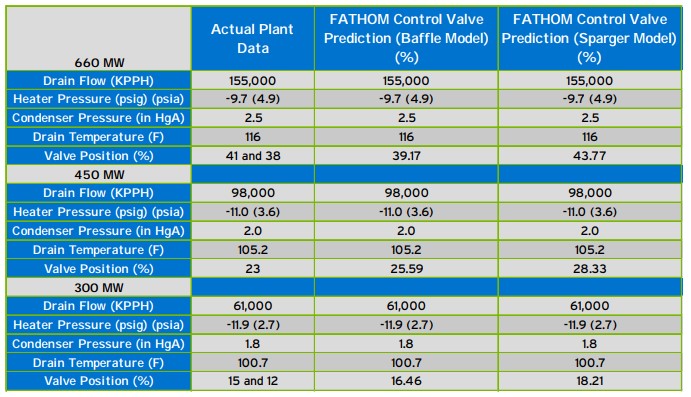
AFT Fathom benchmark results and measured control
valve position data for heater gravity drain system